
Testing mobile applications has always been a bit messy.
Traditional automation provides us with scripted steps. Tap here, type there, check this, and we execute those steps repeatedly. It works… until it doesn’t.
Enter Goal-Based Agentic Testing.
Many people use big words to describe it. But at its core, goal-based agentic testing is simple.
Instead of telling a test exactly how to do something, you tell a test what you expect it to achieve.
And you let an agent, something capable of making decisions, figure out the details.
This sounds fancy, and it can feel futuristic, but there’s real value here for mobile testing if you strip away the noise around AI.
Let’s discuss what it actually means for the work we do and why it matters.
What “Goal-Based” Really Means
Most mobile test automation today is scripted.
Let’s look at a simple Android Jetpack Compose login test using the Robot pattern.
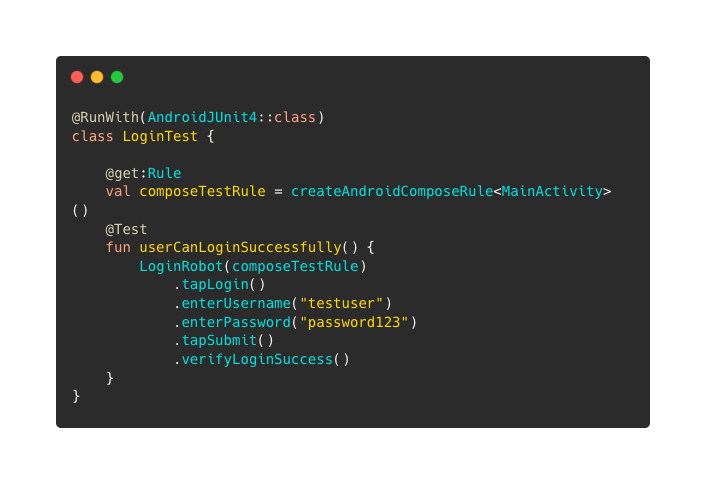
The test is sufficient until the UI changes, or a new dialogue appears, or network delays slow things down.
With goal-based agentic testing, you define the intention, not the exact steps.
The test above might look like:
Goal: Ensure a valid user can open the app, log in, and reach the home screen.
How the agent achieves that is up to the system; it might tap login, it might dismiss a pop-up first, it might take a different path altogether.
The key difference is:
- Scripted tests tell the automation framework exactly how to complete a task.
- Goal-based agents define the outcome and let the test agent work out the path.
In mobile apps, where screens move and pop-ups happen, that distinction matters.
Why This Is Interesting for Mobile
Mobile apps are chaotic environments.
A single flow can involve:
- Permission dialogs.
- Offline/online transitions.
- Different OS behaviours.
- Unpredictable state changes.
Scripted tests are prone to breaking easily in that context. They assume a fixed path.
An agent that understands goals can react to variations.
For example, if an agent encounters a permissions prompt, it can decide how to handle it and continue towards the goal. Scripted tests, on the other hand, just fail unless they are specifically designed to expect it to happen and cater for it.
That doesn’t mean scripted tests go away; it means we now have another way to cover flows that change often or are brittle when hard-coded.
Where Goal-Based Agentic Testing Helps Most
This approach isn’t a replacement for all testing, but it fits well in certain areas.
Exploratory Regression
Instead of writing hundreds of precise flows, the agent explores and achieves outcomes based on user intent.
This can uncover unexpected paths you weren’t thinking of.
Early Feature Validation
When features are evolving fast, predefined scripts break constantly. An agent focused on outcomes can still verify that core objectives are met without rewriting scripts every time.
Complex Variations
Mobile apps often behave differently under different conditions (network, permission states, background/foreground). Goal-oriented agents can adapt better than rigid scripts that only know one path.
What This Doesn’t Fix
This won’t magically solve all mobile app testing problems.
Goal-based agentic testing doesn’t replace:
- Unit tests.
- API and backend integration tests.
- UI tests.
- Carefully written acceptance criteria.
- Exploratory testing.
It doesn’t guarantee edge case coverage either; it’s a tool to help reduce brittleness, not define correctness for every condition.
A Realistic View on Agentic Tests
There’s a temptation to think “AI will just test for us.”
It won’t.
Agentic testing systems might be able to:
- Find paths through your app.
- Handle variation better than rigid scripts.
- Adapt to UI changes.
But they still need good signals to know whether a goal is truly met, UX cues, API feedback, stable identification of screens, etc.
Without that, the agent is just guessing.
How This Fits With What We Already Do
It actually complements the testing approaches many mobile teams already use.
Think of goal-based agentic testing as:
- Another layer of validation.
- A complement to structured tests.
- A way to stress paths that are hard to script.
We still use unit tests for business logic, UI tests for deterministic behaviours, and manual tests for exploratory coverage.
Goal-based agents sit alongside these, giving us another lens on quality.
Final Thoughts
Goal-based agentic testing sounds futuristic because it feels like we’re giving tests more responsibility.
In practice, what it really does is change the question we ask:
From:
“Can we execute these steps?”
To:
“Does this flow still succeed under variation?”
That shift, from steps to goals, is where the value lies.
If your current mobile tests struggle with maintenance, brittle flows, or flaky runs, experimenting with goal-based agents might be worth a look.
But like any tool, it’s not a silver bullet.
It’s just another way to give your app a better chance of surviving the real world.
